Immediate Gas Emergency Safety Protocol
If anyone smells the distinctive "rotten egg" odor of natural gas, hears hissing near pipes or meters, or suspects a gas leak, you must leave the building immediately. Do not touch any electrical switches, do not use phones indoors, do not ignite matches, and do not attempt to operate valves. Once safely outside and well away from the premises, call 911 and your local utility provider (such as National Grid) immediately. Do not re-enter the structure until emergency personnel or the utility company officially clear the building.
Professional Gas Line Repair in Stapleton, Staten Island
Natural gas fuels the majority of heating systems, domestic water heaters, and cooking ranges throughout Stapleton and neighboring Staten Island communities. Because gas lines carry combustible fuel under constant internal pressure, strict adherence to technical safety codes and rigorous craftsmanship is non-negotiable. Whether you are dealing with aging schedule 40 black malleable iron piping in a pre-war colonial basement, installing a new high-output gas range, or resolving a utility shutoff notice from National Grid, NY Plumbing provides the licensed expertise required.
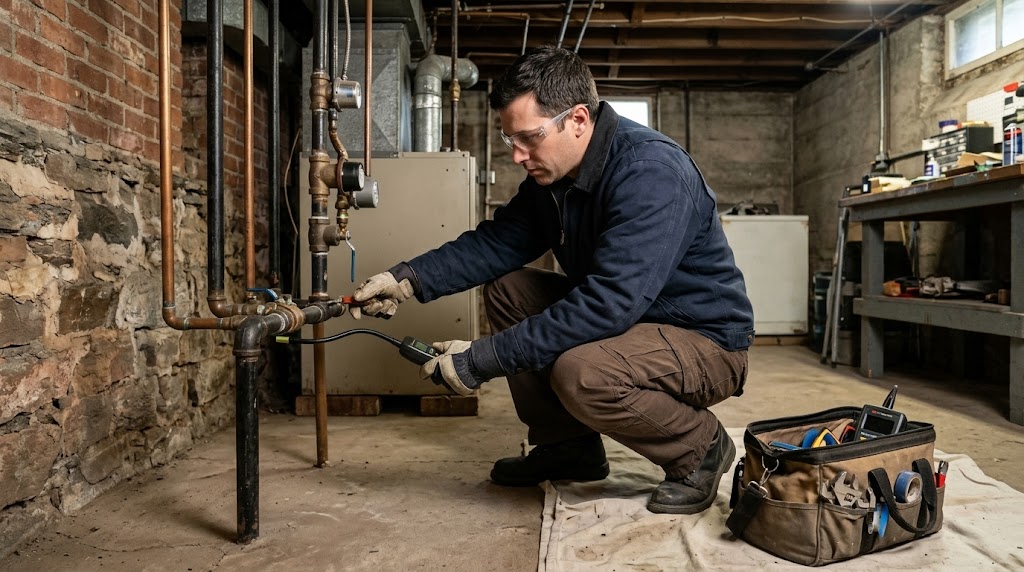
Our gas line repair Stapleton Staten Island services combine precision electronic combustible gas leak detection, mechanical manifold pressure testing, and code-compliant pipe fabrication to guarantee total safety for occupants and property.
Common Warning Signs of Gas Piping Deterioration
Outside of sudden catastrophic leaks, residential and commercial gas systems often exhibit gradual deterioration due to humidity, age, and physical stress:
Intermittent Odors
Faint mercaptan odors detected near meter manifolds, water heater burners, or basement utility rooms often point to micro-leaks at threaded fittings or aged pipe dope seals.
External Surface Rust
Basements with damp stone foundations or high humidity cause severe exterior oxidation on bare black iron pipes, gradually thinning pipe walls and compromising joint threads.
Stiff or Frozen Shutoff Valves
Vintage brass plug cocks and quarter-turn isolation valves frequently seize due to internal lubrication drying out, preventing emergency shutoff during servicing.
Yellow or Weak Appliance Flames
If boiler pilots, water heaters, or stove burners burn with an unsteady yellow flame or produce soot, gas pressure may be dropping due to interior pipe scale obstructions.
Comprehensive Gas Piping Inspection & NYC Local Law 152
In New York City, gas safety is heavily regulated to protect dense residential and commercial neighborhoods. Our certified technicians carry out rigorous gas piping inspection Stapleton Staten Island protocols:
- NYC Local Law 152 Compliance: Multi-family buildings (Class A and B structures containing three or more dwelling units) must undergo periodic visual and electronic gas piping inspections at mandated four-year intervals. We conduct thorough examinations of all exposed gas piping from the building entrance to public spaces, hallways, and boiler rooms.
- Precision Leak Detection: We employ calibrated digital combustible gas sniffers capable of detecting methane concentrations down to parts per million (PPM), paired with non-corrosive bubble solution testing on all joints.
- Manometer Pressure Decay Testing: We isolate gas pipe sections and introduce nitrogen or compressed air to test for pressure drops over time, verifying that systems hold static pressure under rigorous standards before re-energizing.
- Appliance Hookups & Gas Range Installation: Connecting a new gas dryer, cooking range, or commercial stove requires proper pipe sizing, CSA-certified flexible connectors, and dedicated manual shutoff valves within six feet of the appliance.
Restoring Service After Utility Meter Lock-Outs
If National Grid or the fire department has red-tagged your gas meter and shut off supply due to a detected leak or pressure loss, recovering your gas heat and hot water requires a systematic code-driven procedure:
Diagnostic Pressure Isolation
We systematically cap and isolate individual branch lines to locate the exact fitting, valve, or pipe section leaking under pressure test conditions without having to dismantle the entire system unnecessarily.
Code-Compliant Repair & Sign-off
We replace compromised piping with heavy-duty schedule 40 black steel pipe, install new ball valves, file necessary DOB permits, and coordinate with municipal and utility inspectors to secure rapid service reconnection.
Why Professional Installation is Strictly Mandatory
Never attempt DIY gas line repairs or use unauthorized materials like teflon tape designed only for water lines. Gas fittings require specific yellow gas-rated PTFE tape or non-hardening anaerobic thread compounds. All installations must satisfy the New York City Fuel Gas Code to prevent fire hazards, explosions, or carbon monoxide accumulation.
Schedule Professional Gas Line Inspection in Stapleton
Need scheduled gas piping repair, boiler gas valve replacement, or Local Law 152 inspection? Call our local office for prompt technical service.
Call (315) 202-8009Frequently Asked Questions About Gas Line Services
Immediately evacuate all occupants from the building. Do not operate light switches, landlines, or mobile phones inside. Extinguish open flames and do not start vehicles in attached garages. Once safely outside and well away from the structure, call 911 and your natural gas utility provider (such as National Grid). Do not re-enter until utility personnel or first responders declare the building safe.
NYC Local Law 152 mandates periodic inspection of exposed gas piping systems in all buildings containing three or more dwelling units at least once every four years, according to community district schedules. The inspection must be performed by a Licensed Master Plumber to verify pipe integrity, check for unauthorized alterations, and identify any active leaks.
Yes. When a gas utility detects a pressure drop or leak and locks or removes the meter, service cannot be restored until a Licensed Master Plumber isolates the failure, repairs the piping according to NYC Building Code, files the appropriate DOB permits, and performs a witnessed high-pressure decay test.
Natural gas is highly flammable and combustible under pressure. Improper thread sealants, incorrect flare fittings, cross-threading, or using improper flexible connectors can lead to hazardous gas leaks, fire, or carbon monoxide accumulation. By law in NYC, all gas work must be permitted and installed by licensed plumbing professionals.